
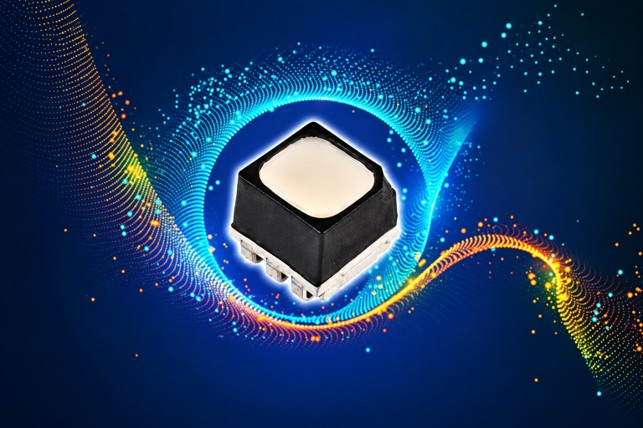
With OptiLamp, Cree LED integrates drivers, control and monitoring functions directly into the pixel. A new approach to LED display architecture that aims to simplify design and improve image quality, energy consumption and maintenance.
In LED displays, improving performance does not necessarily mean adding new components. An alternative route consists of Reconsidering the architecture of the system, by transferring some of the functions normally entrusted to external electronics directly inside the LED.
This is the principle behind OptiLamp™, the technology developed by Cree LED that It brings integrated control logic to the individual pixel. Each LED thus becomes an active element of the system, capable not only of generating light but also of controlling the brightness. manage your own output and provide information about your status.
The goal is to intervene simultaneously on some of the main parameters of an LED display: project complexity, visual quality, energy consumption, reliability and maintenance.
The difference compared to traditional LED architecture starts with the control system.
In a conventional display, LED management requires a series of external IC drivers. With OptiLamp, however, the control logic is transferred inside each pixel, and direct control of the individual LED die is replaced by digital communication lines to the integrated driver.
The control flow can thus proceed digitally from pixel to pixel, reducing the amount of external electronics required. The platform It allows you to manage strings up to 4,096 pixels, equivalent to a 64×64 matrix, keeping each pixel individually controllable.
Within the component there is a ASIC with control logic, analog circuitry, ADC and temperature sensor. Distributed intelligence therefore not only represents a software function, but becomes an integral part of the electronic architecture of the LED.
Bringing the driver inside the pixel allows, first of all, to reduce the number of components present on the board.
A simpler PCB requires fewer parts and materials and can contribute to the creation of thinner and lighter displays. Production can also benefit from the reduction of components and connections, with effects on assembly times and on the cost of materials.
Cree has also maintained for OptiLamp a format similar to that of standard LEDs. The OLY6D-FKC model, for example, measures 2.8 × 2.8 mm. The goal is Allowing designers to adopt the new architecture without radically changing the pixel layout, favoring applications of a type drop-in.
There is also another interesting aspect: since the pixel change is managed through a digital command, the same hardware architecture can be configured for different combinations of color depth and frame rate.
The size of the data packets indeed determines a design compromise: smaller packets allow higher frame rates or strings with a higher number of pixels, while larger packets allow increasing the color depth.
One of the most significant aspects of the OptiLamp architecture concerns the scan report.
In traditional multiplexed LED displays, not all rows are illuminated simultaneously. With a 1:2 scan, 50% of the rows are active simultaneously; with a 1:4 scan, 25% are active, and with a 1:8 scan, 12.5% are active.
The driver present in each pixel, on the other hand, allows OptiLamp to operate with a True Architecture 1/1 scan, In which all the lines can be illuminated simultaneously.
This eliminates some of the typical compromises of multiplexing. In particular, Cree indicates the Possibility of achieving greater brightness without increasing the driving current or the generated heat, and eliminating phenomena such as line scan, tearing and banding.
These are important characteristics in general for image quality, but they become particularly relevant when the display is captured by video cameras: scan rates and synchronization can indeed cause the appearance of banding and flickering in images intended for video productions or broadcast.
The integration of pixel-level control also offers advantages in image management.
OptiLamp supports different color depths up to 16 bit depth, in the proposed configurations, at 24 bits per RGB channel, for a total of 72 bits. Color depth, number of pixels, and frame rate can be configured according to the needs of the application.
Each pixel can also be adjusted along the entire brightness range, from 0 to 100%. The ability to actually bring the LED to 0% allows for deeper blacks and increases the contrast between the bright and dark areas of the image.
Synchronization at the inter-pixel level, on the other hand, helps maintain uniform brightness and chromatic accuracy across the entire surface of the display.
To this is added a high refresh rate, which is especially important with video, graphic transitions and moving text: By increasing the frequency with which the image is updated, it is possible to reduce perceived flickering, motion blur, and instability.
The 1/1 scan architecture also addresses one of the most significant problems of large LED displays: the energy consumption.
In multiplexed systems, the LEDs must be driven at peak currents during the period when they are active to achieve the required perceived brightness. OptiLamp, on the other hand, can operate with medium-current LEDs, taking advantage of the simultaneous activation of the pixels.
According to Cree LED, this operating mode It can lead to savings of up to 40% on operational costs related to energy consumption, While maintaining the required brightness, the available margin can be used to further increase the current and achieve higher brightness levels.
The advantage takes on particular importance in large screens and installations intended to operate for many hours per day, where energy consumption significantly impacts on the cost of ownership. Total Cost of Ownership of the plant.
The integration of electronics into the pixel finally opens up a possibility that goes beyond image quality: using the LED itself as a source of information for maintenance.
OptiLamp makes it available diagnostic data on the state and performance of the components, This allows for the detection of potential problems before they become visible on the display.
The goal is to move from a predominantly reactive maintenance approach to a more proactive one, intervening before the failure occurs and reducing the downtime of the plant.
The calibration also makes use of distributed intelligence: each LED can communicate and memorizing your calibration data, By simplifying procedures and reducing the need to resort to traditional binning processes.
The characteristics of the technology make OptiLamp particularly suitable for applications where image quality, brightness, power consumption and operational continuity must be managed simultaneously.
Among the areas indicated by Cree LED are: large outdoor video screens, stadium displays, billboards and digital signage, traffic displays, decorative lighting, message displays, entertainment installations and transparent displays.
The combination of true 1/1 scan, high contrast and synchronization management also makes the technology particularly interesting for displays intended for video production and broadcast applications.
To assess the impact of energy efficiency on a concrete project, Cree LED also provides OptiLamp LED Power Calculator App.
The instrument is aimed at designers, manufacturers and operators of displays and allows to compare the consumption of OptiLamp with that of conventional LED technologies, Estimate energy savings and analyze the effect of reducing consumption on operating costs and the return on investment.
The central point of OptiLamp is therefore not a single specific feature, but The shift of intelligence from the system to the pixel.
Integrating the driver and control functions directly into the LED allows for the reduction of external electronics and, at the same time, enables the intervention on parameters that traditionally require tradeoffs between brightness, image quality, power consumption, and hardware complexity.
The pixel thus ceases to be simply the last element of the control chain and becomes an intelligent and manageable component of the display.
The driver’s shift within the LED represents a significant architectural change, which can profoundly change the way next-generation LED displays are designed, produced, and managed.
Would you like to learn more about the features of the OptiLamp™ LED technology and evaluate its integration into your project? Contact us Electronic Center for more information and support in choosing the solution that best suits your needs.
ELECTRONIC CENTER
LTD UNIPERSONAL
276 South Canaletto Street,
41122 Modena (MO)
T 059 3162111
VAT NO. 00931480362
@ info@electroniccenter.it
